Synthetic-to-Real Perception for Agricultural Robotics

Introduction to the series Synthetic-to-Real Perception on NVIDIA Jetson
by Konsulko Group Software Engineer Andjela Danilovic Nedic

A robot working in a sugar beet field has to make a decision for every plant in front of its camera: leave it in place, or treat it as a weed. Before any tool moves, that decision depends on perception, which means locating each plant in the image and classifying it correctly. Building that capability involves two separate engineering problems. The detector must be trained on images that represent the field, and the trained model must run on embedded hardware that can be deployed, updated, and maintained on a working machine.

At Konsulko Group, we built a crop and weed detection workflow that addresses both problems end to end. We generated synthetic training images in NVIDIA Isaac Sim, trained and evaluated RT-DETR detectors with NVIDIA TAO Toolkit, and deployed the selected model on an NVIDIA Jetson Orin Nano 8 GB running Konsulko Orca OS™, our Yocto Project-based Linux distribution for Jetson platforms. Konsulko has experience supporting customers in the agricultural sector, including work on embedded operating systems. This project applied that platform experience to a complete perception application, from training data to inference on the device.

The Training Data Challenge

Selective weed control depends on distinguishing crops from weeds accurately enough to guide treatment. A missed weed may remain untreated, while a crop mistaken for a weed may be damaged. Reliable detection therefore requires training data that captures the visual conditions a system will encounter in the field.

Crop and weed plants can look similar, overlap, or occupy only a small area of an image. Differences in plant size, soil texture, plant residue, shadows, and lighting add further variation. A useful dataset needs to represent these conditions, including small and partially visible plants that are difficult to distinguish from their surroundings.

Collecting representative images can require repeated field visits within limited seasonal windows. Preparing and checking annotations adds further effort, as individual plants must be located and assigned the correct class. These demands make training data a significant part of developing an agricultural perception system.

This led to the central question of this project: could synthetic images reduce the amount of labeled real data needed to train a crop and weed detector?

From Simulation to Real Images

Synthetic data moves much of this effort from the field to the workstation. We used NVIDIA Isaac Sim to build a configurable agricultural scene containing sugar beet plants, weeds, soil, and unlabeled background objects such as straw and stones. A generator script varied plant selection, placement, and size, along with soil appearance, lighting, and camera pose. It used Omniverse Replicator to export each rendered image together with its bounding-box annotations. Because the simulator knows where every plant is, labels are produced as part of rendering rather than drawn afterward.
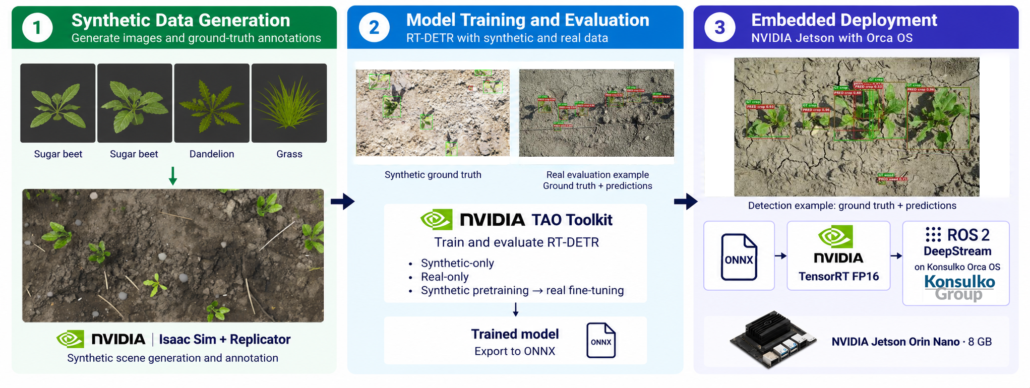
Infographic showing a three-step AI pipeline: synthetic data generation, model training with RT-DetR, and embedded deployment with NVIDIA Jetson Orin.

Figure 1. The synthetic-to-real perception workflow, from scene generation in NVIDIA Isaac Sim to inference on NVIDIA Jetson 

Rendered images are not photographs. Differences in plant geometry, textures, lighting, and object distribution create a domain gap between synthetic and real data, and a model can learn cues that exist only in the rendered images. The value of the synthetic data therefore had to be measured on real images, not judged by how realistic the renders looked.

We trained RT-DETR, a transformer-based object detector, using NVIDIA TAO Toolkit under three approaches: synthetic images only, real images only, and synthetic pretraining followed by fine-tuning on real images. The real images came from a sugar beet subset of the public CropAndWeed dataset, with labels mapped to the same two classes. To see how the benefit of synthetic pretraining changed with the amount of real data, the real-image experiments used nested training subsets of 50, 100, 200, and 512 images. Every model was evaluated on the same held-out real test set, drawn from recording sessions that were not used for training or validation.

Deployment on Jetson with Orca OS

NVIDIA’s ecosystem provided tools for each stage of the workflow: Isaac Sim and Replicator for synthetic data generation, TAO Toolkit for detector training, and TensorRT and DeepStream for deployment on Jetson. This gave the project a path from simulated training images to GPU-accelerated inference on an embedded device.

Orca OS provided the embedded Linux foundation for that deployment. Built on the Yocto Project, with NVIDIA Jetson platform support through meta-tegra, it allowed us to combine a configurable operating system with NVIDIA’s standard application containers. With Docker and the NVIDIA Container Toolkit providing GPU access, we could use NVIDIA’s published DeepStream container and add our trained model, inference configuration, and custom parser without integrating the DeepStream framework into the Yocto image. This kept the perception frameworks and their dependencies within the application containers while the underlying system remained managed through the Yocto build.

We converted the selected model into a TensorRT FP16 engine on the Jetson itself and integrated it into two applications: a DeepStream video pipeline whose annotated output can be viewed in a web browser, and a ROS 2 image-processing pipeline that publishes annotated detection output.

The DeepStream and ROS 2 applications ran in separate containers on the same Orca OS system, sharing the underlying Jetson platform and its GPU resources.
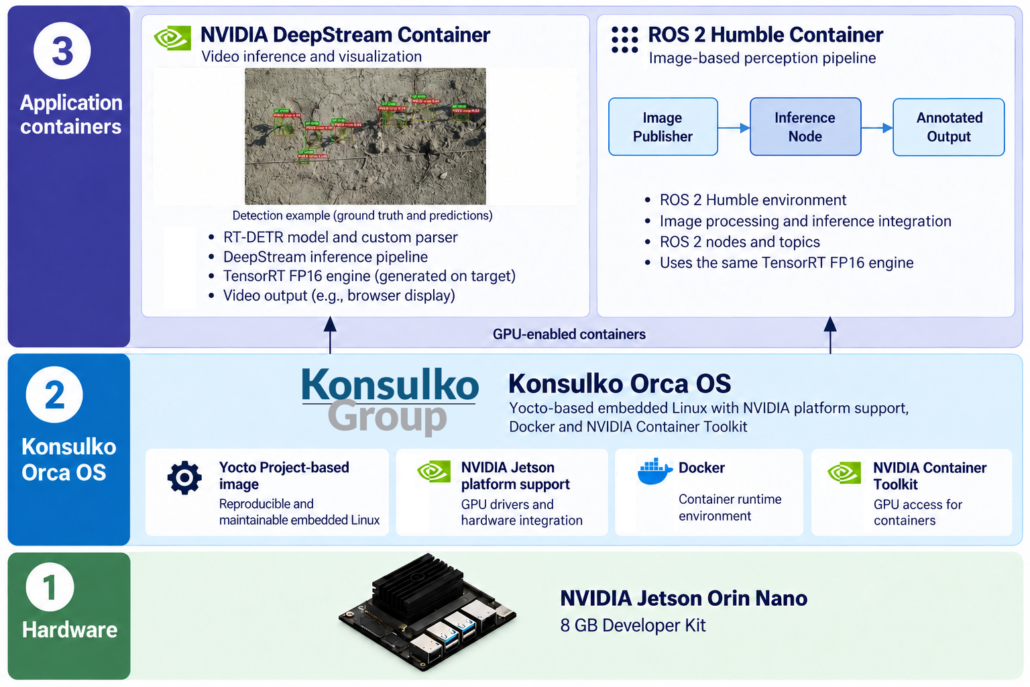
Figure 2. Deployment architecture on NVIDIA Jetson Orin Nano

This separation establishes a clear boundary between the underlying operating system and the perception applications. Platform components can be managed through the Yocto build, while application dependencies remain within their respective containers. This provides flexibility to maintain and update the operating system and applications separately, provided that compatibility between the host and container environments is preserved.

Results and Findings

In our experiments, synthetic pretraining provided the greatest benefit when labeled real training data was limited. With 50 real training images, the synthetic-to-real approach achieved 32.42 AP on the held-out real test set, compared with 8.15 AP for the real-only approach. The advantage narrowed as more real images became available.

On the NVIDIA Jetson Orin Nano running Orca OS, the selected model achieved 39.77 FPS in a standalone TensorRT FP16 benchmark, while the ROS 2 application processed an average of 11.20 FPS. We also demonstrated the DeepStream pipeline with browser-based viewing of annotated video. These measurements describe the tested implementation; performance under live field conditions and integration with a weeding tool remain to be assessed.

Security and Product Maintenance

Agricultural perception systems carry models and algorithms that represent substantial investment in data, training, and engineering. Deploying them on machines introduces a need to protect that intellectual property against unauthorized extraction and to protect the software against tampering. Security also needs to support continued operation as vulnerabilities are discovered and software changes over time.

Orca OS provides capabilities that support these requirements. Secure boot and filesystem integrity verification help protect system software against unauthorized modification, while encrypted storage can protect model files and application data at rest. Over-the-air updates with rollback support software maintenance and recovery from unsuccessful updates. These capabilities require configuration for the target product and were not utilized as part of this perception project.

For products within its scope, the EU Cyber Resilience Act introduces cybersecurity requirements covering product development and maintenance, including vulnerability handling. A software bill of materials supports component tracking and vulnerability assessment, while an update mechanism enables fixes to reach deployed devices. These capabilities support a manufacturer’s compliance work; meeting the requirements also depends on the complete product and the processes used to develop and support it.

In This Series

The three technical articles follow the workflow in order, and each answers one question raised here.

Part 1 – Generating Synthetic Crop and Weed Images with NVIDIA Isaac Sim explains how to design a synthetic scene that a detector can learn from: plant assets for different growth stages, crop rows and weed placement, camera geometry and plant scale, domain randomization, and automated checks on the generated data.

Part 2 – Training RT-DETR with Synthetic and Real Data Using NVIDIA TAO examines when synthetic pretraining helps: dataset preparation, the three training approaches, model selection, and the full evaluation on real images.

Part 3 – Deploying an RT-DETR Perception Model on NVIDIA Jetson with Orca OS covers what it takes to run the model on the device: TensorRT conversion, the DeepStream and ROS 2 integrations, browser viewing, and the performance measurements on Orca OS.

Konsulko provides end-to-end NVIDIA Jetson engineering services: custom carrier board design, board bring-up, Orca OS integration, application deployment, and secure over-the-air updates. Orca OS is delivered as part of an engineering engagement and adapted to each customer’s hardware and product requirements. Contact Konsulko to discuss bringing a perception application from training to a maintainable embedded product.
A Three-Month-Old Bug: Debugging an HDMI Hotplug Fault on TI AM62x

By Filipe Pires, Software Engineer at Konsulko Group

At Konsulko Group, we recently worked on HDMI support for a custom industrial product based on Texas Instruments’ AM62x SoC, using an Analog Devices ADV7511 HDMI bridge. The initial HDMI bring-up went smoothly, and we adapted the device tree from TI’s SK-AM62B-P1 reference design to our custom board. We later migrated the display stack from a legacy framebuffer setup to Wayland and Weston. Wayland is a display protocol that defines communication between applications and the compositor, while Weston is its reference compositor, responsible for managing windows, coordinating rendering, and presenting content on the display.

Everything seemed to be working fine until the customer requested dynamic resolution negotiation and HDMI hotplug detection. What initially looked like a straightforward feature request ended up uncovering a device tree bug that had existed since the original HDMI bring up three months earlier.

The task: stop hardcoding the resolution

Before this work, the display resolution was hardcoded using the video= kernel command line argument, so we weren’t relying on Extended Display Identification Data (EDID) to select the display mode. This worked fine during the initial bring up, but the customer now wanted the resolution to be negotiated automatically based on the connected display.

To support that, we needed to read the monitor’s EDID and handle hotplug events, so that connecting a different display would trigger a new mode detection without requiring a reboot.

The symptom: it works, but only the second time

The first problem we noticed was during boot. Weston would start at a fallback resolution instead of the display’s native resolution. However, restarting Weston manually after the system was up would result in a successful EDID read, and the correct display modes would appear.

We also noticed that unplugging and reconnecting the HDMI cable wasn’t reliably triggering a new mode detection. At that point, we weren’t sure whether the two problems were related.

This was our first clue. The hardware and software were exactly the same, yet restarting Weston was enough to get everything working. We suspected some sort of timing issue during startup, but we still needed to understand what was happening.

Into the driver

To understand why the EDID read was failing, we started looking into how the whole hotplug mechanism worked. This took us through the ADV7511 bridge driver, the Kernel DRM subsystem, and eventually Weston’s DRM backend.

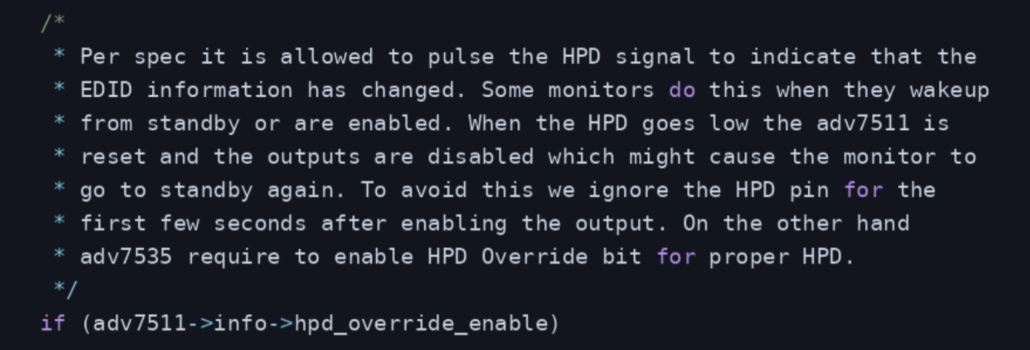
Looking through the ADV7511 driver (drivers/gpu/drm/bridge/adv7511/), one thing that caught our attention was a comment explaining that some monitors pulse their Hot Plug Detect (HPD) signal when waking from standby.

This seemed relevant to what we were seeing. On boot, the monitor might not be ready when the initial EDID read was attempted. By the time we restarted Weston, it had already finished waking up.

To test this theory, we added a small sleep before the EDID read. With that delay, the read succeeded reliably.

That was encouraging, but it wasn’t a proper fix. We couldn’t just introduce an arbitrary delay and expect it to work with every monitor. More importantly, we still needed to understand what was supposed to happen if the monitor became ready after the initial read had already failed.

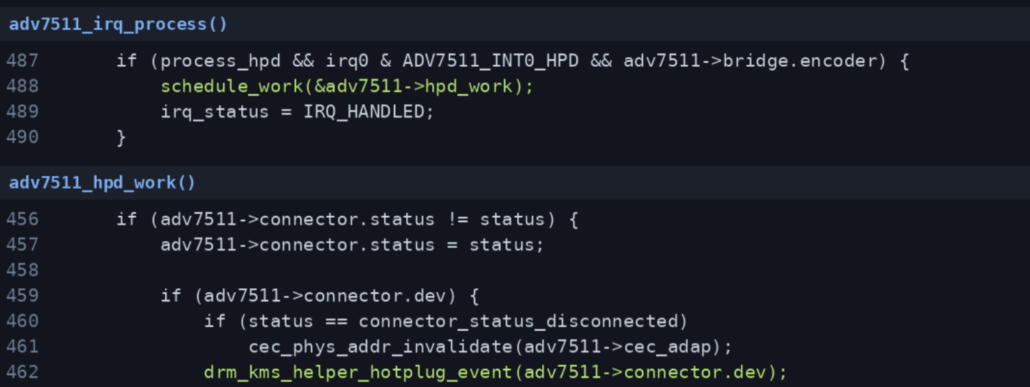
Looking further into the driver, we found that adv7511_irq_process() handles the chip’s interrupt status, including HPD changes. When an HPD interrupt is detected, it schedules adv7511_hpd_work(), which checks the connector status and, if it has changed, notifies DRM through drm_kms_helper_hotplug_event().

This helped us understand an important distinction: the interrupt doesn’t directly trigger an EDID read. Instead, it notifies the rest of the display stack that something has changed. The EDID is read separately through the connector’s mode probing path.

Following drm_kms_helper_hotplug_event() into the DRM core, we found that it eventually calls drm_sysfs_hotplug_event(), which generates a standard Linux uevent with HOTPLUG=1.

We then looked at how Weston handles these events. Its DRM backend registers a udev monitor, and when a hotplug event arrives, udev_drm_event() calls drm_backend_update_connectors(). This updates the connector information and allows Weston to discover the available display modes again.

By this point, we had a much better understanding of the complete path, from the ADV7511 hardware interrupt through the DRM subsystem and all the way to Weston.

With a better understanding of the hotplug mechanism, we started to suspect that the two issues might be connected. The sleep explained why waiting longer allowed EDID to be read successfully, but it couldn’t explain why hotplug events weren’t being handled correctly.

Both problems pointed us back to the hardware interrupt.

Was the ADV7511 interrupt actually reaching the kernel?

The real bug: two lines in the device tree

Following the interrupt path eventually brought us back to the device tree. We knew the ADV7511 driver was expecting an interrupt to notify DRM of a hotplug event, so we started checking how that interrupt was configured on our board.

That’s where we found the problem.

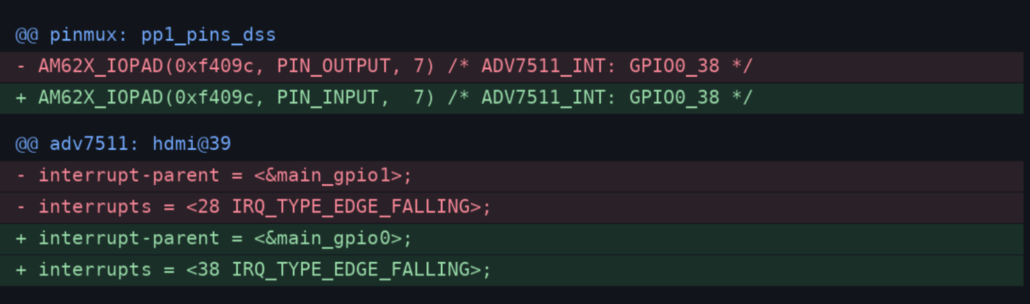
There were actually two issues in the device tree. First, the pad connected to the ADV7511 interrupt line was configured as an output instead of an input. Second, the interrupt properties in the ADV7511 node referenced the wrong GPIO controller and pin.

Patch diff: AM62X IOPAD direction changes from PIN_OUTPUT to PIN_INPUT; ADV7511 GPIO pin label updated and comment preserved.

With this configuration, the interrupt could never reach the driver correctly. This explained why unplugging and reconnecting the HDMI cable wasn’t triggering hotplug detection.

It also explained why the sleep had appeared to fix the boot problem. The delay gave the monitor enough time to become ready before we attempted to read EDID, but it did nothing to fix the missing interrupt.

Once we corrected the pin direction and interrupt mapping, the hotplug mechanism worked as expected. The driver could receive the interrupt, DRM could notify userspace, and Weston could respond to changes in the connected display.

Retrospective

After fixing the issue, we checked the Git history and found that the incorrect configuration dated back to the original HDMI bring up, roughly three months earlier. HDMI output had worked with a hardcoded resolution, so the missing hotplug functionality had gone unnoticed through subsequent device tree changes.

The fix itself was small, but finding it meant tracing the path from the ADV7511 through DRM to Weston. The sleep experiment helped us understand the boot timing, but following the missing hotplug events was what finally led us to the device tree issue.

One lesson from this debugging effort is that getting a peripheral working during bring up doesn’t necessarily mean all of its functionality has been validated. Double-checking GPIO assignments, pin directions, IRQ sources, and polarities against the schematic is worth the effort, even when the peripheral appears to be working as expected.


For more information about Konsulko Group and the engineering services we can provide for your products, please contact us with your specific requirements.

Konsulko to extend Orca OS support to NVIDIA Jetson Thor; creates new live tutorial

Konsulko Group™ is today announcing

  • Konsulko Orca OS™ support for NVIDIA Jetson Thor AGX Developer Kit, including NVIDIA JetPack 7.2 with upstream Yocto Project support
  • A new live tutorial of Secure Boot and On-Target Update running on real NVIDIA Jetson Thor AGX hardware

Konsulko Group is an embedded Linux engineering services company, focussing on both software and hardware. Our engineers have made significant contributions to open source communities, including the Linux kernel, Yocto Project, OpenEmbedded and U-Boot. 

Over the years, Konsulko has provided production-ready, secure, and robust embedded Linux solutions on NVIDIA platforms for our customers building cutting-edge devices. 

The Platform for the Edge

Last November we announced Konsulko Orca OS, a Yocto Project-based Linux distribution optimized for NVIDIA Jetson Orin platforms. Now Orca OS will support the new Jetson Thor-based platforms as well.

Orca OS is sold to Konsulko customers as part of a services engagement. Please contact Konsulko Group for more information.

New Live Tutorial

Konsulko engineers have developed a stand-alone, live tutorial of Secure Boot and On-Target Update running on real NVIDIA Jetson Thor AGX hardware. This is not a simulation, but a real-time demonstration requiring specific Jetson Thor hardware. 

This tutorial can be delivered to interested Konsulko customers and qualified prospects. If you would like to run this tutorial yourself on your own Thor AGX hardware, please contact us to discuss your Jetson-based project. 

We have also created a complete video of the tutorial while it was running live in our labs. This is available today for everyone to view.

About Yocto Project

The Yocto Project is an open source collaboration project that helps developers create custom Linux-based systems regardless of the hardware architecture.

The project provides a flexible set of tools and a space where embedded developers worldwide can share technologies, software stacks, configurations, and best practices that can be used to create tailored Linux images for embedded and IOT devices, or anywhere a customized Linux OS is needed. 

Konsulko Orca OS is built on the Yocto Project, as are many of Konsulko’s solutions for NVIDIA platforms.

Full official Yocto Project support from NVIDIA

As just announced, starting with NVIDIA JetPack 7.2, NVIDIA delivers official Yocto Project support for Jetson developers, providing validated recipes and tools. Yocto Project on Jetson enables custom Linux distributions that optimize system performance, while bit-for-bit reproducibility ensures deterministic builds. You can build your production-ready applications on Yocto Project with confidence.

For more information

Please contact us to discuss how Konsulko Group and Orca OS can help build your next breakthrough Edge AI product.

Konsulko Group extends Edge AI practice on Jetson, joins NPN

Konsulko engineers have a long history providing hardware and software services for our customers deploying artificial intelligence in embedded products, particularly on NVIDIA® platforms.

We offer end-to-end Jetson™ development services for the entire NVIDIA Jetson family, including custom hardware designs, board bring-up and application integration with OTA updates. Some of our particular expertise includes:

  • Expert migration from NVIDIA L4T to a custom, production-grade Yocto distribution
  • Implementation of Secure Boot, authenticated UEFI, disk encryption, and per-device keys to protect IP and data at the Edge
  • CUDA and AI workflow integration for flexible AI deployment
  • Integration of powerful OTA solutions like Mender and RAUC for reliable, secure, and scalable A/B differential updates
  • Board Support Package (BSP) development for custom carriers, device tree configuration, and system performance tuning
  • Real-Time Linux Kernel (Preempt-RT) support for applications requiring deterministic performance and low latency

Last November, we announced Konsulko Orca OS™, a production-ready Linux operating system designed for secure, high-performance AI applications on NVIDIA Jetson platforms that can be delivered to Konsulko customers as part of a services engagement. Built on the Yocto Project, it offers secure boot, encrypted storage, and reliable over-the-air (OTA) updates, optimized for NVIDIA Jetson Orin platforms.

Emphasizing a security-first approach, Orca OS utilizes NVIDIA secure boot and dm-verity for a read-only root filesystem, plus dm-crypt/LUKS for encrypted data. Its Yocto Project foundation ensures reproducible builds, an automatic Software Bill of Materials (SBOM), and tailored SDKs, all backed by broad industry support.

Recently, Konsulko Group was selected to join the NVIDIA Partner Network (NPN), a global ecosystem of technology partners designed to help design, build, and deliver NVIDIA AI-accelerated computing solutions. We look forward to working with NVIDIA and the many members of NPN as we continue to help our customers around the world develop successful products.

Please contact us to discuss your engineering services requirements for your next Jetson-based project.

Konsulko Group: The Year in Review 2025

In 2025, as in our previous 13 years in business, Konsulko Group focused on the practical hardware and software engineering that help companies build breakthrough embedded devices. More and more, this has been with a specific emphasis on deploying Edge AI. We worked alongside companies creating real-world products using AI-capable hardware in medical devices, robotics, smart transportation, and industrial automation.

Beyond our core services, we announced a new platform for Edge AI and published technical guides to address common integration challenges. The following highlights cover the technical work and resources we delivered this year to support embedded product development.

Introducing Konsulko Orca OS for Edge AI

On November 2, we launched Konsulko Orca OS, the production-ready Linux operating system designed for secure, high-performance AI applications on NVIDIA Jetson platforms. Built on the Yocto Project, and delivered as part of Konsulko Group’s software services, Orca OS is engineered from the ground up for deployment in real-world, commercial products, featuring long-term support, secure boot, encrypted storage, hardened production builds, remote diagnostics, reliable over-the-air (OTA) updates and cloud management.

Konsulko also offers end-to-end Jetson development services for the entire NVIDIA Jetson family, including custom hardware designs, board bring-up and application integration with OTA updates.

Custom Hardware for Complex Embedded Systems

Konsulko continued to deliver hardware design services ranging from schematic capture and PCB layout to rapid prototyping, custom SOMs and carrier boards, to manufacturing management. Serving the consumer electronics, medical, telecommunications, and industrial sectors, our engineers integrate robust hardware design with secure, production-ready software to accelerate our customers’ deployment of their devices.

Production Engineering for Medical and Utility Robotics

Our services work in 2025 focused heavily on deploying Edge AI in regulated and industrial environments. For example, we provided a production-secure, encrypted OS using Yocto and a mainline Linux kernel to serve as a base for AI applications operating at the edge for smart grid monitoring systems. 

Konsulko assisted with two separate medical device projects, both built on the NVIDIA Jetson platform. For both projects, we migrated the underlying OS from NVIDIA L4T to a production-ready Yocto Project distribution. A key requirement was creating and maintaining a custom SDK to enable their developers to build CUDA applications. Additionally, we ensured another medical device running on Yocto remained current by updating it with the latest NVIDIA SDK releases.

Addressing Hardware Security on NVIDIA

Implementing a full Chain of Trust on high-performance SoCs remains a significant challenge for engineering teams. In July, we published the technical guide, Cybersecurity on NVIDIA: Why Embedded Lags Enterprise Linux.

Embedded Linux systems, even on popular platforms like NVIDIA Jetson, can sometimes lag behind enterprise Linux distributions in terms of cybersecurity practices and promptness of security updates. This guide provides a high-level overview of the methodology and components utilized to secure Jetson hardware on production projects. 

The process establishes a hardware-based root of trust, which is then extended to verify the integrity of every subsequent boot stage, all the way to the Linux userspace. Furthermore, the solution incorporates encryption-at-rest to protect sensitive intellectual property in deployed systems.

Standardizing Hardware-in-the-Loop Testing (Labgrid)

At Open Source Summit Europe in August, Konsulko Principal Software Engineer Tim Orling (with Trevor Gamblin of Bay Libre) presented Powering Up: Lab Automation With Labgrid and CI. This highlighted a standardized testing infrastructure we can use for customer projects. 

We can utilize Labgrid (a Python library for embedded control) to integrate physical boards into the Continuous Integration pipeline. Instead of relying on QEMU or manual QA, we automate power cycling, serial console interaction, and GPIO manipulation on actual hardware to catch regressions in the boot process or hardware interaction layers before code reaches the client.

We have also leveraged this capability to support the U-Boot community. Specifically, we enabled the community to run their existing test suite automatically in Gitlab CI. This automation covers four distinct hardware platforms and various software configurations.

Executing Windows CE to Linux Migration

As Konsulko Principal Software Engineer George McCollister described in his technical blog post Migrating from Windows CE to Yocto-based Embedded Linux in January, our team managed several legacy migration projects for industrial customers. These projects involved porting application logic from deprecated Windows CE environments to supported Yocto Project-based Linux builds. 

We delivered modernized OS images that maintained existing application behavior while moving the underlying system to long-term supported (LTS) kernels, mitigating the security risks associated with end-of-life operating systems.

Explaining “Embedded Systems” to professionals in other fields

Those of us working in this field for 20-30 years (or more) can sometimes forget that the basics — what these systems are and the steps we take every day to make them work — may seems very foreign to folks in corporate management, finance, or students and newcomers to embedded engineering.

To this end, Konsulko Group started a series of informational articles. The first asks the overarching question: What is Embedded Systems Design?

Continuing our Contribution to Open Source communities

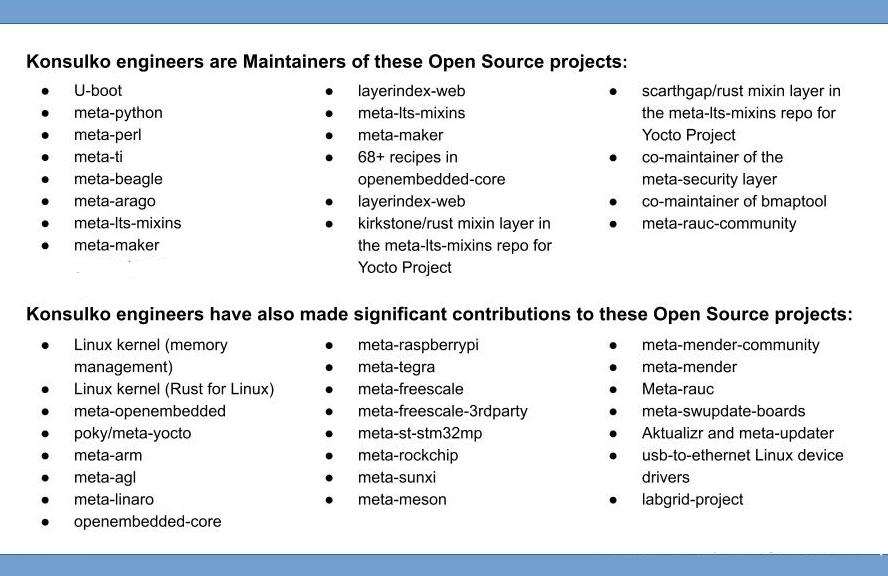
Throughout 2025, Konsulko engineers maintained their seats on the OpenEmbedded Board of Directors and the Yocto Project Technical Steering Committee, and played a key role in organizing and presenting at multiple community events. Our engineers continue in the role of project maintainer and make significant contributions to numerous Open Source projects.

We look forward to working with you in 2026 on building your next embedded device. Please contact us anytime to discuss your new or on-going hardware and software requirements.

Introducing Konsulko Orca OS, the Platform for the Edge

Konsulko Orca OS™ is a secure, production-ready, and commercially supported Linux operating system designed for Edge AI and IoT devices. 

Delivered as part of Konsulko Group’s extensive software services for companies developing embedded devices, Orca OS provides a robust and reliable foundation for your products, enabling secure boot, encrypted storage, and reliable over-the-air (OTA) updates. 

Optimized for NVIDIA Jetson Orin platforms, Orca OS allows you to leverage powerful AI and machine learning frameworks in a secure and manageable environment.

Production-Ready by Design

Orca OS is engineered from the ground up for deployment in real-world commercial products. It includes long-term support, failsafe A/B OTA updates with rollback, hardened production builds, remote diagnostics, and cloud management via Azure IoT Hub. 

Emphasizing a security-first approach, Orca OS utilizes NVIDIA secure boot and dm-verity for a read-only root filesystem, plus dm-crypt/LUKS for encrypted data.

Built on Yocto Project

Konsulko Orca OS is built on the Yocto Project, and based on the latest stable and LTS Yocto Project releases. Yocto Project allows for the creation of custom Linux-based systems with unparalleled control and efficiency. 

Key advantages include broad industry and community support, reproducible builds from same source inputs, tailored SDKs for application development, and automatically-generated Software Bills of Materials (SBOMs) for security and compliance.

Bring Your AI Vision to the Edge

In addition to Orca OS, Konsulko provides end-to-end Jetson development services. From the earliest TK1 to the latest Orin and Thor families, Konsulko Group delivers production-ready, secure, and robust embedded Linux solutions for the entire NVIDIA Jetson family. From custom board bring-up to application integration with OTA updates, we provide the deep expertise you need.

To unlock the full potential of your edge devices with the security and reliability of Konsulko Orca OS and Edge AI services, please contact us today. Our expert team is ready to help you customize the platform that meets your specific product needs.

Cybersecurity on NVIDIA: Why Embedded Lags Enterprise Linux

Embedded Linux systems, even on popular platforms like NVIDIA Jetson, can sometimes lag behind enterprise Linux distributions in terms of cybersecurity practices and promptness of security updates. Here’s why:

Customization and Divergence

Embedded Linux systems often involve significant customization and the use of specialized components (including NVIDIA hardware), which can diverge from the more homogenous use cases served by the enterprise Linux vendors that have one-size-fits-all distributions.

Resource Constraints

Embedded devices typically operate with limited resources (power, memory, processing power). These constraints can hinder the adoption of certain advanced security features available in enterprise Linux environments.

Update Cycles

Embedded systems, especially in critical infrastructure or applications, often have longer lifecycle requirements (lasting 10 years or more) compared to enterprise systems (typically 3-5 years). Constraints on cost and available bandwidth for metered data service (such as an LTE modem) can be a consideration as well. This can result in slower security patching and updates, leaving devices vulnerable to known exploits.

Threat Models

Embedded systems often face a different threat model compared to enterprise systems, including the possibility of physical access by attackers. This requires a tailored approach to security that may not be fully addressed by enterprise-focused solutions.

Less Stringent Security Measures

Traditionally, embedded devices sometimes lack robust mechanisms for detecting tampered files or unauthorized data access, making them attractive targets for offline attacks. 

Making Embedded Systems Secure

Konsulko Group has always worked with our customers to help them build secure embedded products, including new “AI on the Edge” devices on NVIDIA platforms.

Building a Chain of Trust

Konsulko engineers use their expertise to establish a secure boot process, ensuring the integrity of the system and core software from boot-time to end-of-life. This involves encrypting, verifying, and measuring the integrity of the system and core software at each stage.

Integration with Yocto Project and Key Management

We integrate security technologies within the Yocto Project framework for embedded Linux development, and manage cryptographic keys, which are crucial for secure communication and data protection.

On-Going Support and Maintenance

We offer services to support the long-term security and maintenance of these systems, helping to bridge the gap between enterprise and embedded security practices over the device’s lifecycle.

Security, Secure Boot and Chain-of-Trust Experts on NVIDIA platforms

Konsulko Group has extensive expertise in commercial device security, with proven expertise in security-critical and production-ready systems. We have an embedded-first mindset with a focus on long-term maintainability, and have been a trusted partner in embedded Linux and NVIDIA ecosystem development.

Our engineers have had over two decades working with the open source technologies necessary to help you effectively manage and support the security of your project. We have real customer success across medical, industrial, transportation and defense sectors.

Please contact us to learn how our engineering team can accelerate your next embedded product.