Integrating VNC/Weston with the Yocto Project/OpenEmbedded
Leon Anavi
Yocto Project Virtual Summit 2023
Leon Anavi
Yocto Project Virtual Summit 2023
Konsulko Group senior engineer Leon Anavi will be presenting at the Yocto Project Virtual Summit, Tuesday, November 28 through Thursday, November 30, 2023.
Formerly known as the Yocto Project Developer Day, the Summit has an expanded scope to include both workshops for engineers building customized Linux distributions and applications, as well as an open forum where maintainers, trainers and users present papers on how the project is evolving and how they are using it.
On Wednesday, November 29, Leon will present Integrating VNC in Weston with the Yocto Project and OpenEmbedded. Weston 12 introduces Virtual Network Computing (VNC) support, allowing remote connection and control through graphical desktop sharing.
Leon will examine the technical aspects — dependance on Neat VNC and AML libraries, TLS support and user authentication — followed by a step by step tutorial to demonstrate remote connection from another computer.
The presentation aims to simplify the process of setting up the VNC backend in Weston and empower developers to utilize this powerful feature seamlessly within their projects.
We hope you will join us for this presentation, and all of this new edition of Yocto Project Virtual Summit.
(This article was written by open source software enthusiast and Konsulko Group intern Atanas Bunchev, working with Konsulko Senior Engineer Leon Anavi.)
Konsulko Group often works with Mender.io to provide secure, risk tolerant and efficient Over-The-Air updates for any software on an embedded device. This includes both solutions for robust system updates as well as updates of single applications. Mender is compatible with any Linux based OS, including popular build systems such as Yocto Project/OpenEmbedded, Buildroot and OpenWrt.
Aside from OTA updates Mender also offers several add-ons. These are optional extensions that provide functionality for use cases beyond the core OTA updates features.
One such use case is remote troubleshooting. In practice deployed devices in the field are often hard to reach or retrieve. Troubleshooting individual devices becomes resource inefficient and in some cases they have to be replaced even when it’s just a small software or configuration issue. Our experience has shown in these situations Mender’s Add-ons have proven to be extremely useful.
This article provides as an example, the exact steps how to integrate Mender with The Yocto Project and OpenEmbedded for SolidRun CuBox-I and HummingBoard as well as a demonstration of the Mender Troubleshooting package, more specifically the File Transfer and Remote Terminal Add-ons. With the File Transfer add-on files can be downloaded and uploaded to any accepted device. Remote Terminal add-on allows remote interactive command execution from the Mender UI.
These add-ons are very valuable for system administration and mantainance of Internet of Things or fleets of connected industrial devices. For an example, we will troubleshoot an embedded Linux device remotely with systemd using Mender add-ons. We will upload tools to gather system boot-up performance statistics, run them on the device thanks to the Remote Terminal and download logs for further debugging.
Any Mender enabled device is suitable for this demonstration. Recently the Konsulko Senior Engineer Leon Anavi ported Mender to SolidRun CuBox-I and HummingBoard with NXP i.MX6 SoC so our current setup is based on this hardware platform and Yocto LTS release Kirkstone. Earlier we also ported RAUC, an alternative free and open source OTA update platform to the same hardware. If you are interested in software updates, please contact us to discuss your own embedded product needs in details. The hardware used in this example is:
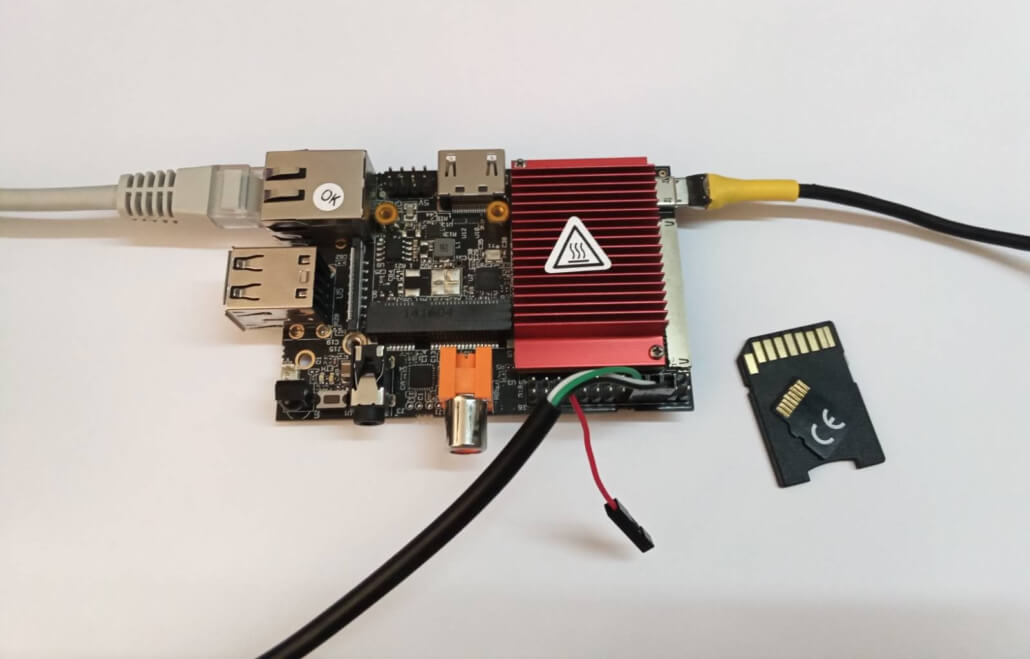
The Mender Community provides a set of examples for integration with various hardware platforms using Yocto/OpenEmbedded in the meta-mender-community repository. Sub-layer meta-mender-nxp in this repository contains the integration for Cubox-I/HummingBoard.
The meta-mender-nxp layer uses Google Repo to provide easy and simple setup and build process for the examples:
$ mkdir mender-nxp && cd mender-nxp
$ repo init -u https://github.com/mendersoftware/meta-mender-community \
            -m meta-mender-nxp/scripts/manifest-nxp.xml \
            -b kirkstone
$ repo sync
$ source setup-environment nxpTo configure the build system we have to append to conf/local.conf inside the build directory.
First we are going to set the build target machine:
MACHINE = "cubox-i"Then we have to accept the end user agreement required by the BSP layer:
ACCEPT_FSL_EULA = "1"Note: Usually to enable Mender’s Troubleshooting features we have to add mender-connect to IMAGE_INSTALL. In our case this is already added by the meta-mender-demo layer.
We have to provide our device with MENDER_SERVER_URL and MENDER_TENANT_TOKEN.
For that reason we have to register at https://mender.io/.
Mender provides a free demo profile with limitation of 1 year and up to 10 devices which can be used to experiment with all of Mender’s features.
In fact, when sourcing the setup-environment script we get most of the mender-specific configuration appended to local.conf. This includes a description of how to get our tenant token:
# Build for Hosted Mender
#
# To get your tenant token:
#    - log in to https://hosted.mender.io
#    - click your email at the top right and then "My organization"
#    - press the "COPY TO CLIPBOARD"
#    - assign content of clipboard to MENDER_TENANT_TOKEN
#
#MENDER_SERVER_URL = "https://hosted.mender.io"
#MENDER_TENANT_TOKEN = ""
Note: If using the European server one has to set MENDER_SERVER_URL = "https://eu.hosted.mender.io"
Once we assign our tenant token and remove the # in front of MENDER_SERVER_URL and MENDER_TENANT_TOKEN we’re ready to build our system.
Build an example image with Yocto:
$ bitbake core-image-baseBuilding an image from scratch is a long process involving a lot of tasks. Please patiently wait until bitbake completes all tasks.
Once the build is complete flash the image to the microSD card (replace /dev/sdX with the proper device path) and boot it on the HummingBoard:
$ bmaptool copy tmp/deploy/images/cubox-i/core-image-base-cubox-i.sdimg.bz2 /dev/sdX
$ sync
$ eject /dev/sdXOnce the board finishes booting it will poll the Mender server. By design the connection has to be established from the board to the server. Mender does not open any ports on the board to provide better security therefore the device has to initiate the connection.
When the connection is established the Mender control panel will indicate one pending device.
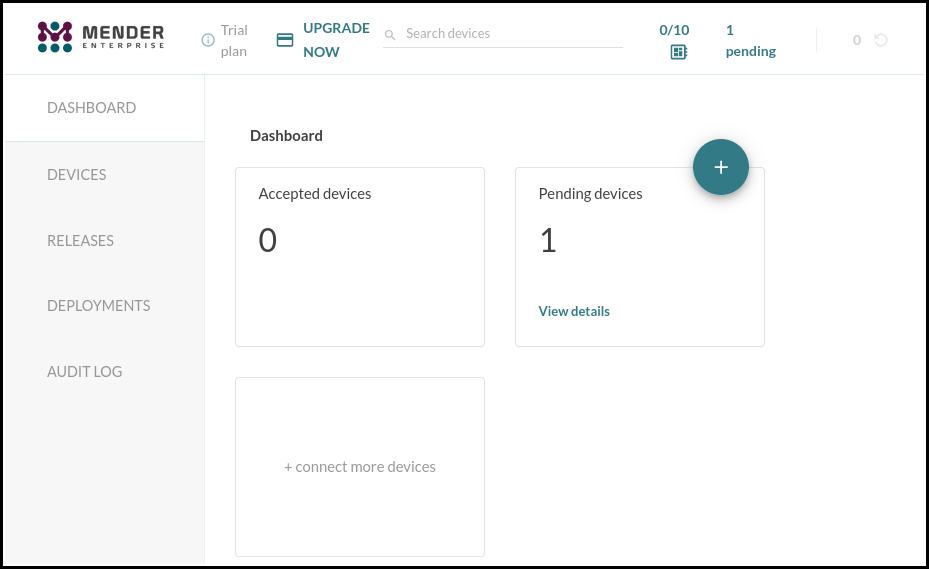
To accept the request click on View details under Pending devices.
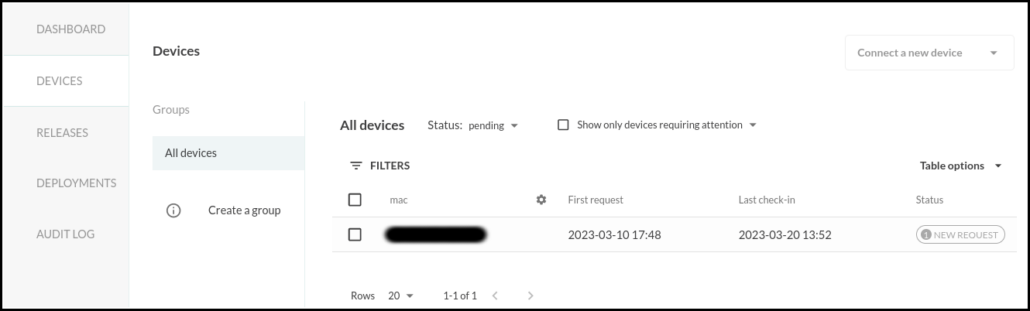
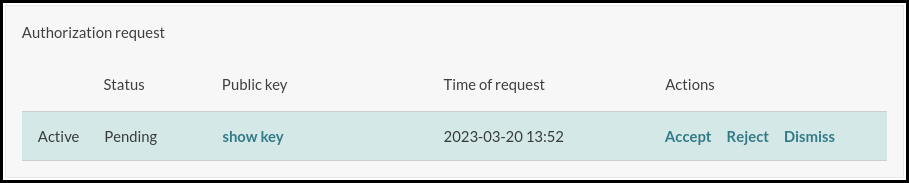
Select the new device and press accept in the Authorization request section.
Once the connection is accepted head over to the Troubleshooting tab in the Device information section. Here you can launch a remote terminal and transfer files.
The next part of the article will demonstrate preparing, uploading and using systemd-analyze to fetch data about the boot process.
To compile systemd-analyze we have to add it to our image in conf/local.conf:
IMAGE_INSTALL:append = " systemd-analyze"Rebuild systemd to get the systemd-analyze binary:
$ bitbake systemd -c compileWhen using the do_compile command Yocto/OpenEmbedded will preserve the compiled binaries.Find the systemd-analyze binary and libsystemd-shared-<version>.so shared library:
$ find tmp/work -name "systemd-analyze"
$ find tmp/work -name "libsystemd-shared*.so"
Note: As of the time of writing of this article these files should reside in locations similar to ./tmp/work/cortexa9t2hf-neon-poky-linux-gnueabi/systemd/1_250.5-r0/build/systemd-analyze and ./tmp/work/cortexa9t2hf-neon-poky-linux-gnueabi/systemd/1_250.5-r0/build/src/shared/libsystemd-shared-250.so. These paths depend on the exact version of systemd as well as the build configuration and may not be correct in your case.
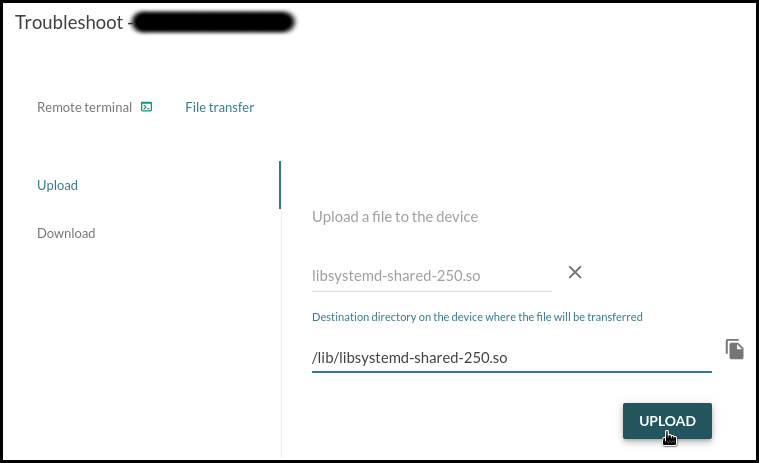
Upload these files to the board using Mender’s File Transfer utility:
systemd-analyze into /usr/bin/libsystemd-shared-<version>.so into /usr/lib/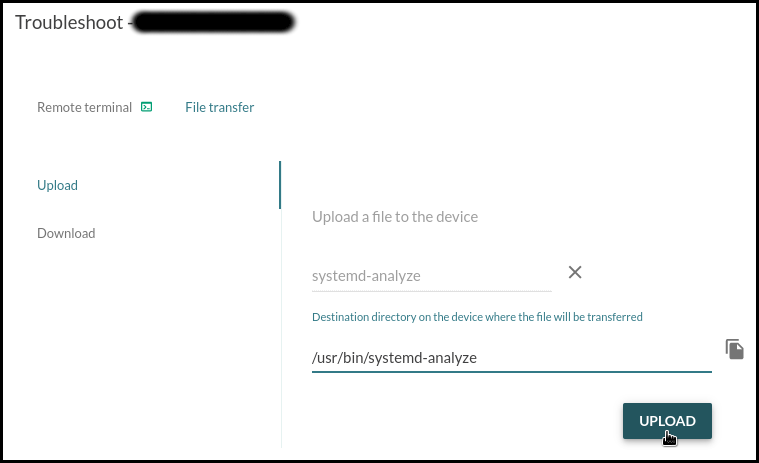
Once the troubleshooting software is uploaded we can use the Remote Terminal to execute it.
Permit execution of the systemd-analyze binary:
# chmod +x /usr/bin/systemd-analyzeCheck the time it took for the system to initialize:
# systemd-analyzeExport a graphic of all enabled services and the time they took to initialize:
# systemd-analyze plot > init.svg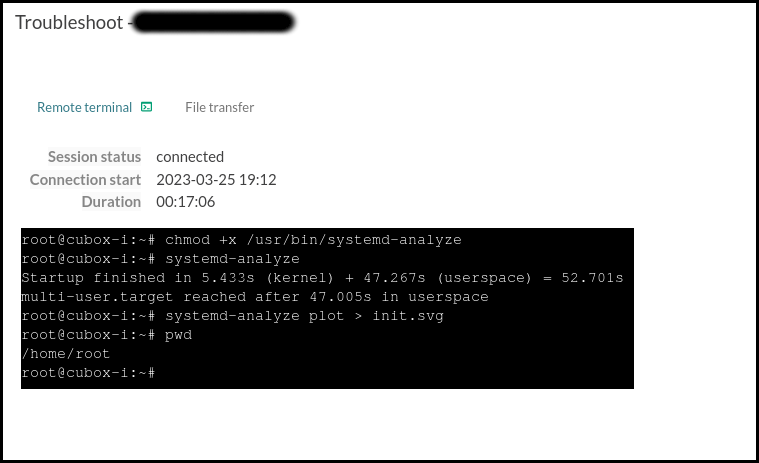
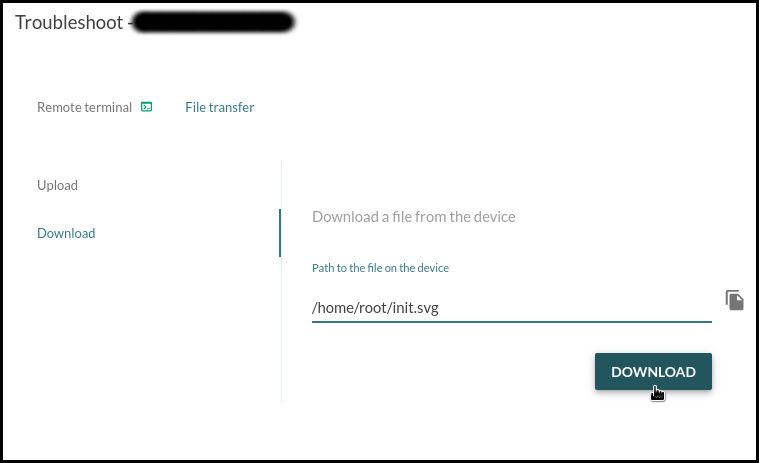
Download init.svg:
This graphic shows that the device needs around a minute to reach multi-user.target. The longest task is the resizing of the /data partition that runs on first boot and the second longest is the filesystem check for mmcblk1p1 that runs every time the system boots.

Here is another graphic generated after a reboot:

This article demonstrates how to use Mender’s Remote terminal and File Transfer troubleshooting utilities to upload and execute the systemd-analyze binary to profile the initialization process of systemd services. These troubleshooting utilities can be used for variety of different tasks. After debugging a single device and finding an appropriate fix, Mender is capable of performing an A/B or delta software update to all devices or specific group of devices in the field.
Since the earliest days of the OpenEmbedded build framework and the Yocto Project, Konsulko engineers have been contributing to the community and helping customers build commercial products with these technologies. We have experience with RAUC, Mender and other open source solutions for software updates. Please contact us to discuss your own embedded product needs.
Taking place February 4 & 5, 2023 in the beautiful city of Brussels (Belgium), FOSDEM is a two-day event organized by volunteers to promote the widespread use of free and open source software.
This year, Konsulko Group senior software engineer Leon Anavi will present Ups and Downs with Remote Desktop Protocol (RDP) on Wayland, Weston and the Yocto Project.
Leon’s tutorial provides the exact steps to build-from-scratch core-image-weston, setup RDP and remotely access the embedded device using wlfreerdp (for Wayland) or xfreerdp (for X11) from a personal computer with Linux in the same network. Examples will be based on the kirkstone long-term support release of Yocto Project.
Leon will also discuss the advantages and the disadvantages of RDP as well as some troubleshooting guidelines.
If you are attending FOSDEM, be sure to to catch this lightning talk at the Embedded, Mobile and Automotive devroom on Saturday.
2022 went by quickly with Konsulko engineers working closely with our customers, our partners and the open source community. For the tenth straight year, Konsulko Group has helped our clients build outstanding commercial products with Embedded Linux, Yocto Project and OpenEmbedded, as well as deploying Over-the-Air (OTA) software updating.
We had particular success with our Konsulko Continuous Time Engagement™ offering, providing dedicated engineering resources for two of the world’s largest semiconductor companies. This model provides guaranteed engineering time for an agreed period. KCTE has allowed our customers to use our engineers on a variety of their requirements, and switch between these tasks as the rest of their project and in-house engineering required.
Of course, many of our clients prefer Konsulko OnDemand Time Engagement™, SOW-based engineering for high level consulting, on-demand support, and specific tasks within a larger project. KOTE is also best for longer term engagements without a hard deadline that can be stopped and started as necessary, and projects with an expected pause (such as bring-up of new hardware which almost always results in a re-spin of the PCB).
We continue our strong relationship with the Linux Foundation and Automotive Grade Linux. We worked with mender.io and PHYTEC, providing support and development for their customers. With our friends at ICS, we presented at a joint webinar in August, Software Update Mechanisms: Selecting the Best Solution by Konsulko’s Leon Anavi and ICS’ Jeff Tranter.
Our Konsulko engineers were active participants (often in person, sometimes virtually) in conferences and developer gatherings. Leon Anavi, Vitaly and Maria Wool, and Tim Orling made presentations at the Embedded Linux Conferences (North America and Europe), FOSDEM and Yocto Project Summits:
Tim also posted a technical paper on Using kernel config fragments to remove an unwanted feature.
The bar is pretty high for joining Konsulko Group. Some of our team have thirty years experience with embedded software and Linux. Most have over twenty and all have over fifteen years, working (and playing) with Linux and the open source community. So we were happy to welcome Denys Dmytriyenko and António Oliveira to Konsulko Group this year.
Denys is a long time Open Source Software developer, contributing code to many FOSS projects, like glibc, PostgreSQL, KDE, MythTV, LIRC, OpenEmbedded, and Yocto Project. Before joining Konsulko Group, he worked as Software Developer and Architect for Texas Instruments for almost 20 years on numerous Embedded Linux (MIPS and ARM-based) products. Since 2011 Denys has served on the OpenEmbedded Board of Directors, and since 2019, on the Yocto Project Technical Steering Committee. He is a long time contributor and maintainer of numerous recipes and layers in the OpenEmbedded/Yocto Project universe.
António has worked in development of highly optimized hardware and software ranging from deeply embedded microcontrollers to full-fledged graphical user interfaces. During this time, he has gained extensive experience in build automation tools, analog and digital circuits, powerline communications, and low power and low frequency radio communications. An active member of the open source community, he has contributed to Yocto Project and the Linux kernel. In addition to his work as an embedded engineer, António served eight years on the executive board of his local parish in Portugal, including four years on the municipal council.
We hope you will have the opportunity to work with Denys, António and the rest of Konsulko Group in 2023.
Hyatt Regency Seattle | Seattle, Washington + Virtual
For over 15 years, Embedded Linux Conference (ELC) has been the premier, vendor-neutral technical conference for companies and developers using Linux in embedded products. Recent ELCs have expanded the scope to include both the user-space developers building applications on embedded Linux as well as the architects and developers working to deliver smart connected products and industrial IoT solutions.
At the upcoming Embedded Linux Conference, September 27- 30, 2021 at the Hyatt Regency Seattle (with a virtual option available), Konsulko Group engineers will give detailed technical talks on building RISC-V Linux systems, and Linux A/B upgrades.
Tuesday, September 28 • 4:00pm – 4:50pm
Principal Software Engineer (and GM Konsulko AB) Vitaly Vul (aka, Vitaly Wool) will discuss new hardware designs based on RISC-V, an open standard instruction set architecture. In modern times, RISC-V SoCs quite often have QSPI flash onboard which makes them perfect candidates to use XIP (eXecute In Place) technology to execute directly from flash without copying the code to RAM first. That allows to optimize memory footprint very tightly and thus opens up to really low-power IoT Linux appliances. Vitaly will present a demo how to run a mainline kernel configured for XIP on a RISC-V board, and discuss extending XIP support for RISC-V to 32-bit and MMU-less systems for low-key battery-powered RISC-V systems with RAM shortage.
Wednesday, September 29 • 1:30pm – 2:20pm
Senior Software Engineer Leon Anavi will discuss deploying software upgrades to fleets of embedded Linux IoT devices, using A/B redundant systems with two identical partitions using popular open source solutions (like Mender or RAUC). Although they provide great features out of the box there are still plenty of technical obstacles to overcome for real-world use cases. In this presentation, we will walk through practical experiences using both Mender and RAUC with Yocto Project and OpenEmbedded. Leon will discuss BSP integration and porting efforts for new devices, bootloader requirements and configurations, tips and tricks for ARM and x86-64 systems, read-only file systems, partition layouts, storing persistent data during upgrades, managing single-file artifacts, simultaneous setup with Docker and other containers.
Join us in Seattle or virtually for this always informative, educational and fun conference for commercial and community embedded Linux developers.
Leon Anavi
Virtual ELC Europe 2020
Join us at the Linux Foundation’s Embedded Linux Conference Europe, the premier vendor-neutral technical conference for embedded Linux developers, presented virtually on October 26–29, 2020.
Konsulko Group’s Leon Anavi will give a talk on Software Update Solutions for Yocto Project and OpenEmbedded, exploring the integration in Yocto and OpenEmbedded of A/B and binary delta updates over the air or through a USB stick.
No matter where you are in the world, here’s a good chance to experience ELC Europe for a fraction of the cost of the in-person event.
RAUC is a secure, robust and flexible open source software for A/B updates of Embedded Linux devices. It is appropriate for various use cases and it is compatible with all popular build systems: The Yocto Project/ OpenEmbedded, Buildroot and PTXdist.
Konsulko Group engineers have experience with all popular open source solutions for software over the air updates of embedded Linux devices, including Mender, SWUPdate, HERE OTA Connect based on OSTree and Aktualizr. In this article we will discuss the exact steps to integrate RAUC with the Yocto Project (YP) and OpenEmbedded (OE) for Raspberry Pi – the most popular single board computer among students, hobbyists and makers.
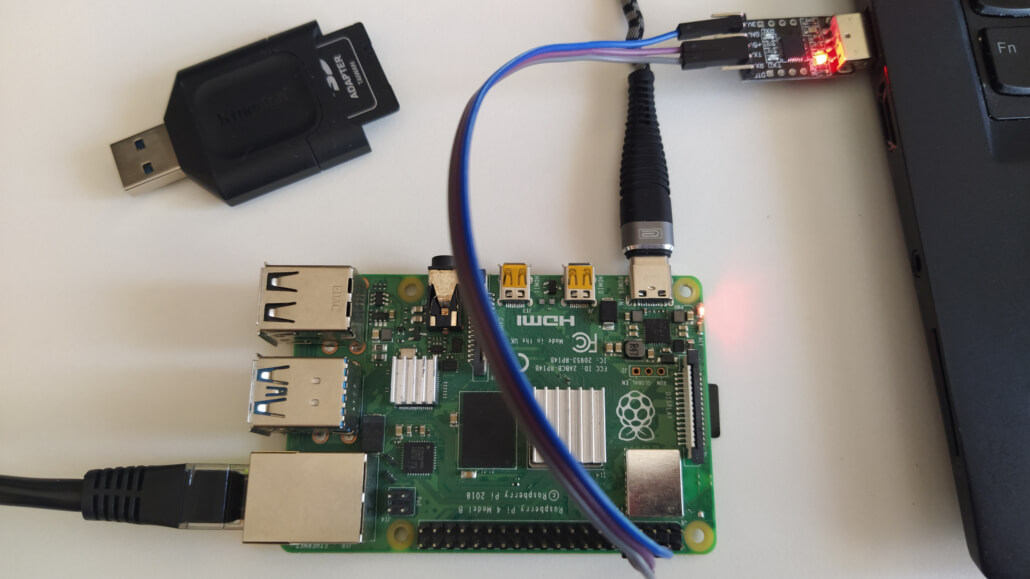
For the practical example in this article we will be using the latest and greatest Raspberry Pi as of the moment: Raspberry Pi 4 Model B. Versions with different RAM sizes are available on the market. Any of these Raspberry Pi 4 Model B versions are OK for this RAUC demonstration.
As long time developers and users of the Yocto Project and OpenEmbedded, both have become favorite tools for creating customized distributions for Konsulko engineers. We frequently use and support them commercially. The Yocto Project is a Linux Foundation collaborative open source project for creating custom Linux distributions for embedded devices. It is based on Poky, the reference distribution of the Yocto Project, using the OpenEmbedded build system. The Yocto Project releases on a 6-month cadence. As of the time of this writing, the latest stable release is Dunfell (3.1).
RAUC is a powerful and flexible open source solution that requires advanced skills for initial integration. To use RAUC in an image for Raspberry Pi built with the Yocto Project and OpenEmbedded, it requires:
RAUC is capable of covering various use cases and scenarios, including advanced options for single or redundant data partitions. Upgrades are performed through the so called RAUC bundles. It is possible to install them over the air or using the old-fashioned method with a USB stick. For managing updates to a fleet of Internet of Things, it is possible to integrate RAUC with Eclipse hawkBit project that acts as a deployment server with a nice web user interface.
For the sake of simplicity, this article focuses on the most simple and straight-forward use case with 2 identical RAUC slots: A and B. For each slot we will have a separate partition on the microSD card for Raspberry Pi. We have already covered most of the RAUC requirements in an additional Yocto/OE layer called meta-rauc-raspberrypi. We will use it to put the pieces together. First we will build a minimal bootable image for Raspberry Pi 4 with RAUC. We will flash it to both A and B slots. After that we will build a RAUC bundle that adds the text editor nano. Finally we will install this RAUC bundle on the B slot, reboot and verify that nano is present.
Building a Linux Distribution with RAUC
Follow the steps below to build a minimal image for Raspberry Pi with Yocto, OpenEmbedded and RAUC as well as to perform a software update:
git clone -b dunfell git://git.yoctoproject.org/poky poky-rpi-rauc
cd poky-rpi-rauc
git clone -b dunfell git://git.openembedded.org/meta-openembedded
git clone -b dunfell git://git.yoctoproject.org/meta-raspberrypi
git clone -b dunfell https://github.com/rauc/meta-rauc.git

git clone -b dunfell https://github.com/leon-anavi/meta-rauc-community.git
source oe-init-build-env
bitbake-layers add-layer ../meta-openembedded/meta-oe/
bitbake-layers add-layer ../meta-openembedded/meta-python/
bitbake-layers add-layer ../meta-openembedded/meta-networking/
bitbake-layers add-layer ../meta-openembedded/meta-multimedia/
bitbake-layers add-layer ../meta-raspberrypi/
bitbake-layers add-layer ../meta-rauc
bitbake-layers add-layer ../meta-rauc-community/meta-rauc-raspberrypi/
MACHINE = "raspberrypi4"

DISTRO_FEATURES_append = " systemd"
VIRTUAL-RUNTIME_init_manager = "systemd"
DISTRO_FEATURES_BACKFILL_CONSIDERED = "sysvinit"
VIRTUAL-RUNTIME_initscripts = ""

IMAGE_INSTALL_append = " rauc"

IMAGE_FSTYPES="tar.bz2 ext4 wic.bz2 wic.bmap"
SDIMG_ROOTFS_TYPE="ext4"
ENABLE_UART = "1"
RPI_USE_U_BOOT = "1"
PREFERRED_PROVIDER_virtual/bootloader = "u-boot"

WKS_FILE = "sdimage-dual-raspberrypi.wks.in"
Build a minimal bootable image:
bitbake core-image-minimal
NOTE: Building an image from scratch requires a lot of operations and takes some time so please patiently wait until bitbake completes all tasks.
sudo umount /dev/sdX*
bzcat tmp/deploy/images/raspberrypi4/core-image-minimal-raspberrypi4.wic.bz2 | sudo dd of=/dev/sdX
sync
IMAGE_INSTALL_append = " nano"
bitbake update-bundle
cd tmp/deploy/images/raspberrypi4/
python3 -m http.server
wget http://192.168.1.2:8000/update-bundle-raspberrypi4.raucb -P /tmp
rauc install /tmp/update-bundle-raspberrypi4.raucb
reboot

which nano
rauc status

For Internet of Things and other real-world products, the whole build procedure with the Yocto Project and OpenEmbedded can be optimized further to just a few commands for easy implementation of continuous integration (CI).
Konsulko engineers have been there since the earliest days of the OpenEmbedded build framework and the Yocto Project. We have experience with RAUC and various other open source solutions for software updates. Please contact us if you need your “own” rock-solid Linux distro for your own embedded product.
Leon Anavi
ELC North America (Virtual) 2020